By Doer Digitalz
🌐 https://doerdigitalz.com
Artificial intelligence is no longer something we only hear about in movies or technology conferences. It is already helping people write emails, analyse information, answer customers, create designs, prepare reports, translate languages and automate repetitive work.
This has also created a very common question:
Will AI replace our jobs, or will it help us create better ones?
There is no simple yes-or-no answer. AI will change some jobs, reduce the need for certain tasks and create new opportunities at the same time. The bigger change may not be people being replaced by AI, but people learning to work differently because of AI.
Why Are People Worried About AI and Jobs?
Whenever a new technology becomes widely used, people naturally wonder what it means for their work.
AI feels different because it can perform tasks that previously required human effort. It can summarise documents in seconds, answer common customer questions, organise large amounts of information and generate content much faster than a person starting from scratch.
For someone who spends several hours every day doing repetitive computer work, this can feel worrying.
But a job is usually made up of many different tasks. Automating some of those tasks does not always mean the entire job disappears.
AI Is More Likely to Change Tasks First
Imagine an employee who receives dozens of customer enquiries every day.
Without AI, that employee may spend hours reading messages, answering the same basic questions, entering customer details and preparing follow-up messages.
With the right AI tools, some of this routine work can be automated.
The employee can then spend more time handling unusual customer problems, speaking with important clients and making decisions that require experience.
In this situation, AI has not necessarily removed the employee.
It has changed what the employee spends time doing.
📘 Click here to download your 💰 Ultimate Generative AI Workbook
Repetitive Work Is the Most Obvious Target
Tasks that follow predictable patterns are generally easier to automate.
Examples include:
- Basic data entry
- Repetitive email responses
- Appointment reminders
- Simple document summaries
- Routine reporting
- Frequently asked customer questions
- Sorting and organising information
Businesses already use software to automate many of these activities. AI simply allows automation to handle more complex information than traditional software could.

Will Some Jobs Disappear?
Some roles will almost certainly become smaller or change significantly as technology improves.
This is not unique to AI.
ATMs changed banking jobs. Online shopping changed retail. Smartphones changed photography, communication and navigation. Cloud software changed how businesses manage files and information.
AI is another major technological shift, although its impact could reach a wider range of occupations.
The important distinction is between a job disappearing and a task disappearing.
If AI can perform 20% of someone’s daily work, the company may redesign that role rather than remove it. If technology eventually performs most of the role’s main tasks, however, demand for that particular type of work could decline.
That is why different occupations will experience AI differently.
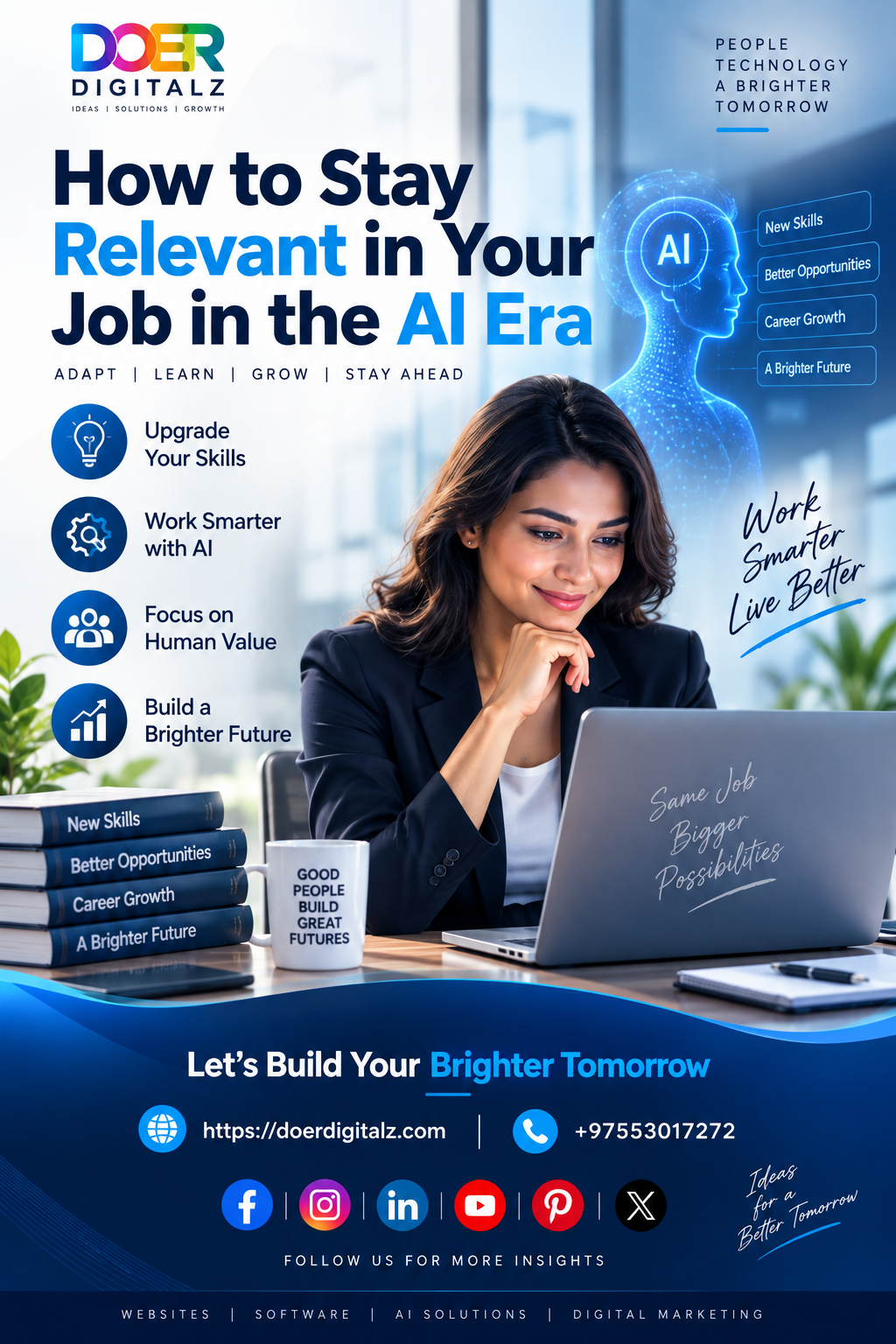
AI Can Also Create New Jobs
Technology does not only remove work. It creates new needs.
As businesses adopt AI, they need people who can implement systems, check results, protect data, integrate software, train employees and decide where automation actually makes sense.
This is already creating opportunities around areas such as:
AI and Automation
Businesses need people who understand how to connect AI with websites, customer systems, internal software and everyday business processes.
AI Quality and Human Review
AI can make mistakes.
Companies still need humans to review important information, check accuracy and decide whether an AI-generated result is appropriate.


Data and Security
AI systems depend heavily on information. Protecting that information and controlling who can access it becomes increasingly important.
New Business Services
AI also allows small companies and individuals to provide services that previously required much larger teams.
A small business, for example, can use technology to automate enquiries, prepare information, organise leads and communicate with customers without hiring a separate person for every small task.
The Valuable Skill May Be Knowing How to Use AI
People do not necessarily need to become programmers or AI engineers.
An accountant can learn how AI helps analyse financial information.
A salesperson can use AI to organise leads and prepare follow-ups.
A teacher can use it to prepare learning materials while still deciding what students actually need.
A designer can use AI for early ideas while applying human creativity to the final work.
A business owner can automate repetitive administration and spend more time with customers.
The useful question is therefore changing from:
“Can AI do my job?”
to:
“Which parts of my job can AI help me do better?”
That is a much more practical way to prepare for the future.
What AI Still Cannot Replace Easily
AI can process enormous amounts of information quickly, but speed is not the same as human understanding.
Many jobs depend on qualities such as trust, responsibility, judgement, leadership, empathy, negotiation and real-world experience.
Consider a customer who is angry about a serious problem.
AI might suggest a technically correct response. A skilled employee may understand that the customer needs reassurance, flexibility or a solution outside the normal process.
That difference matters.
The strongest workplaces may therefore be those that combine machine efficiency with human judgement.
AI Should Be a Tool, Not a Shortcut for Everything
There is another side to the discussion.
Using AI for every task can create new problems.
Employees may stop checking information carefully. Businesses may automate customer interactions that actually require a human conversation. Confidential information can be mishandled. Incorrect AI-generated information can be accepted without verification.
Good AI adoption is not about replacing as many people as possible.
It is about identifying where technology genuinely saves time while keeping human responsibility where it matters.
How Can Workers Prepare for an AI Future?
The safest approach is not to compete with AI at tasks that machines can perform extremely quickly.
Instead, people can learn how to use these tools while strengthening abilities that remain strongly human.
Communication, problem-solving, creativity, decision-making, industry knowledge and relationship-building will continue to matter.
At the same time, understanding basic AI tools may become as normal as knowing how to use email, spreadsheets or search engines today.
You do not have to understand exactly how an AI model is built.
You need to understand how to use it responsibly and when not to trust it blindly.

10% discount COUPON
[copy_inline text=”DOER”]

COUPON
[copy_inline text=”NNN12″]
What Should Businesses Do?
Businesses should also avoid adopting AI simply because it is popular.
Start with a real problem.
Where is your team losing time?
Which tasks are repeated every day?
Where do customers wait too long?
Which processes regularly produce errors?
Once the problem is clear, businesses can decide whether AI, automation, traditional software or simply a better process is the right solution.
Sometimes the best answer will be AI.
Sometimes it will not.
The Future May Be Humans Working With AI
The debate is often presented as humans versus AI.
The reality is likely to be more complicated.
Some jobs will decline. Some will change. New roles will appear, and many existing jobs will incorporate AI into everyday work.
The people who benefit most may not necessarily be those with the deepest technical knowledge. They may simply be the people who understand their profession well and learn how to use new technology effectively.
AI can work quickly.
Humans bring context, responsibility, experience and judgement.
Combining those strengths could create work that is not only faster, but also more valuable.
Final Thoughts
So, will AI replace jobs or create better ones?
It will probably do both.
The important question for workers and businesses is how they respond to the change.
Ignoring AI completely may become difficult. Depending on it completely can be equally risky.
A better approach is to understand it, use it where it genuinely helps and continue developing the human skills that technology cannot easily reproduce.
The future of work may not belong to AI alone. It may belong to people who learn how to work intelligently with it.

Support DoerDigitalz ☕
Support our work with a coffee—small gesture, big impact.
☕ Buy Me a CoffeeEvery small contribution means a lot. Thank you ❤️